The Best DynamoDB GUI Clients in 2026
There is no single "best" DynamoDB GUI; there are tools built for different jobs. This roundup covers the clients that actually matter in 2026, with every pricing and platform claim re-checked against the vendor's own page on 2026-08-06 (the one exception is dated inline). One of the tools is ours; we say so where it matters and list what it does not do.
The short version
- Best free DynamoDB GUI: NoSQL Workbench for designing tables, dynamodb-admin for peeking at a local table, DocKit for a free open-source live-data client.
- Best paid daily driver: Dynobase remains the most feature-complete incumbent; DynoTable if your questions are SQL-shaped (
JOIN,GROUP BY, aggregates that tools can't run). - Pricing moved this year: Dynomate dropped its $199 one-time license for $10–$29/mo subscriptions (checked 2026-08-06). Re-verify prices before budgeting; ours were all checked on that date.
- Docker/local: dynamodb-admin against the
amazon/dynamodb-localcontainer is still the standard answer, and it's free.
Every DynamoDB GUI compared
Prices and platforms verified against each vendor's own page on 2026-08-06. A dash means not offered or not verifiable from the vendor's docs. (TablePlus's price and platforms are from that date too; only its DynamoDB-connector capabilities are the older 2026-06-10 check, flagged in its section below.)
| Tool | Price | Platforms | Visual query builder | Live data ops | Modeling | JOIN / GROUP BY / aggregates |
|---|---|---|---|---|---|---|
| NoSQL Workbench | Free | macOS / Win / Linux | Operation builder | Limited | Strong | No |
| Dynobase | $9/mo billed annually, or $199 once | macOS / Win / Linux | Yes | Strong | Partial | No (PartiQL only) |
| Dynomate | Free tier; $10–$29/mo billed annually | macOS / Win / Linux | Request editor | Strong | No | No (SQL over exports, beta) |
| DbVisualizer | Free (limited); Pro $199 first yr, $89 renewal | macOS / Win / Linux | Yes (generates SQL) | Solid | No | No (PartiQL only) |
| DocKit | Free (Apache-2.0) | macOS / Win / Linux | Yes (13+ operators) | Strong | No | No (PartiQL only) |
| dynamodb-admin | Free (MIT) | Any (Node) | — | Local only | No | No |
| DynamoIt | Free (GPL-3.0) | Any (JVM) | Basic | Basic | No | No |
| TablePlus | $99–$129 once (1 yr of updates) | macOS / Win / Linux | Filter only | Beta (view/filter) | No | No |
| DataGrip | Paid IDE | macOS / Win / Linux | No | Viewer + PartiQL | No | No (PartiQL only) |
| DynoTable | Free read-only; from $9/mo billed annually | macOS* / Win / Linux | Yes (index picker) | Strong | No | Yes (SQL Workbench) |
* DynoTable's macOS build is Apple Silicon only. Its free plan requires an account and is read-only; see pricing.
How to choose a DynamoDB UI
Pick based on the job you actually do most:
- Live data ops: browse, filter, and edit items in real tables, fast, without the AWS Console. This is the daily-driver case.
- Data modeling: design tables, sort keys, and around your access patterns before you write code.
- Analytics-shaped questions: JOINs,
GROUP BY, aggregates. DynamoDB's own query surface does not do these (more below), so the tool has to compile around the limitation.
| Your main job | Reach for |
|---|---|
| Design tables / GSIs before coding | NoSQL Workbench |
| Browse & edit live data daily | Dynobase or DynoTable |
| Git-shareable saved query collections | Dynomate |
| One GUI for DynamoDB + Elasticsearch / MongoDB | DocKit or DbVisualizer |
| Just see what's in a local table | dynamodb-admin / DynamoIt |
| Already live in a JetBrains IDE | DataGrip |
JOIN / GROUP BY / aggregates over your data | DynoTable (SQL Workbench) |
AWS NoSQL Workbench
Free · macOS / Windows / Linux · modeling-first
NoSQL Workbench is AWS's own "cross-platform, client-side GUI application" and it costs nothing. Its data modeler designs tables and GSIs from scratch or from an imported model, lets you "visualize your access patterns as real DynamoDB operations" against sample data, then commits the model to DynamoDB Local or a real account.
The operation builder is the live half: "view, explore, and query live datasets", with projection and condition expression support, sample-code generation in multiple languages, and table cloning between accounts, regions, and DynamoDB Local. The download includes DynamoDB Local, so offline modeling works out of the box.
It's the best free way to design a table. Treat it as a development and modeling tool — browsing or editing real data all day in it is slow going. Reach for it when you're modeling your single-table design, not when you're debugging a row at 2am. Our NoSQL Workbench alternative page covers the day-to-day gap.
Verdict: the free modeling tool every DynamoDB team should have installed; pair it with a data-ops client.
Dynobase
$9/mo billed annually ($108) or $199 one-time · 7-day trial · macOS / Windows / Linux
Dynobase is the established paid desktop client and still the most feature-complete commercial option. As of 2026-08-06 its pricing page lists a Solo plan at $9/month billed annually ($108), a one-time $199 lifetime license (struck from $249), and a Team plan at $79/month billed annually, all behind a 7-day trial with no credit card.
It covers fast exploration, inline editing, a visual query builder (its headline feature, and the axis every rival gets measured on), import/export in CSV or JSON, code generation for JS/TS, Rust, Go, and Python, and local DynamoDB including Docker distributions.
Two things to weigh. It's closed-source, and its SQL surface is AWS pass-through, so it inherits PartiQL's limits: no cross-table JOIN, GROUP BY, or aggregates. And its changelog lists "Dynobase 2.5.0 Beta" at the top with no release dates (checked 2026-08-06); several rivals have built entire comparison pages on its release cadence, so judge maintenance for yourself before a lifetime purchase.
Verdict: the safe, broad commercial pick if the license cost is fine. Our Dynobase alternative page covers where DynoTable differs, chiefly the and EUR/EU-tax billing.
Dynomate
Free tier + $10–$29/mo billed annually · 14-day trial · macOS / Windows / Linux
Dynomate grew popular as a Dynobase alternative, and its distinctive feature is a request-collection workflow: save queries, chain one request's results into the next with environment variables, organize them in folders, and share the collections through Git. It also does AWS SSO and MFA sign-in inside the app, multi-profile and multi-region tabs, DynamoDB Local, and CSV/JSON export.
Its pricing changed in 2026. When we checked on 2026-06-10 it sold a $199 one-time license; as of 2026-08-06 the pricing page lists a free Community tier and subscriptions at $10, $18, and $29 per month billed annually, with a 14-day trial and a 30-day money-back guarantee.
One honest detail its "SQL console" label hides: it queries DynamoDB table exports with SQL (marked Beta), not your live tables. For Git-friendly, reviewable query collections it's a strong pick; our Dynomate alternative page covers where DynoTable differs.
Verdict: the pick if a shared, versioned library of saved requests is the feature you're shopping for.
DbVisualizer
Free edition (limited) · Pro $199/user first year, $89 renewal · 21-day trial · macOS / Windows / Linux
DbVisualizer is the veteran multi-database SQL client, and its DynamoDB support is real: it browses tables, partition and sort keys, and local and global indexes, edits items including maps and sets with mixed content, and runs PartiQL through its SQL Commander with a visual query builder that generates the statements for you.
Pricing splits into a free edition with a limited feature set and a Pro tier at $199 per user for the first year ($89 renewal), with a 21-day trial and no credit card. If your week spans Postgres, MySQL, and DynamoDB, one tool for all of them is a fair trade.
The trade-off is the same one every generalist makes: DynamoDB is one of dozens of supported databases, the querying is single-table PartiQL, and there's no DynamoDB-native modeling or cost awareness.
Verdict: worth a look if DynamoDB is a side database in a relational-heavy week, not your main store.
DocKit
Free (Apache-2.0) · open-source · multi-datastore · macOS / Windows / Linux
DocKit is a free, open-source desktop client built on Tauri (Rust), which keeps the install small, and it spans five datastores: Elasticsearch, OpenSearch, DynamoDB, MongoDB, and EasySearch. For DynamoDB it has a query builder with primary-key filtering and 13+ operators, plus a PartiQL editor with autocomplete and inline item CRUD.
Its "Agentic Data Studio" AI assistant is bring-your-own-key across OpenAI, Anthropic, DeepSeek, Ollama, and LM Studio, so your data and keys stay on your machine.
Its breadth is also its trade-off: DocKit is a generalist across five stores rather than a DynamoDB-native client, and its DynamoDB querying is single-table PartiQL. No cross-table JOIN, GROUP BY, or aggregates, and no modeling.
Verdict: the best free option if your stack is broader than DynamoDB and price matters.
dynamodb-admin and DynamoIt
Free / open-source · local-focused
For local development there are good free options:
dynamodb-admin is a small MIT-licensed web GUI for DynamoDB Local, dynalite, and LocalStack. Install it globally and point it at your local endpoint:
pnpm add -g dynamodb-admin dynamodb-admin --dynamo-endpoint=http://localhost:8000By default it sets dummy credentials (
key/secret, regionus-east-1) so it connects straight to a local endpoint, which makes it the standard answer for "I just need to see what's in my local table." For a deeper walkthrough of endpoints and dummy creds, see connecting to DynamoDB Local; for how it stacks up as a daily tool, see the dynamodb-admin alternative page.DynamoIt is a free, GPL-3.0 JavaFX desktop viewer that reads your AWS CLI profiles for quick browse/edit work with no login step. It auto-picks scan vs query, paginates, and supports local DynamoDB; the README notes you need at least Java 17 (and Maven) to build and run it.
Verdict: both are great for local and light use and cost nothing; neither aims to be a production workbench.
TablePlus and DataGrip
Generalist SQL clients with partial DynamoDB support
These are excellent relational clients whose DynamoDB support is bolted on rather than native.
- TablePlus added an undocumented DynamoDB connector in 2025: you can view tables and filter items with its visual filter builder, but there's no PartiQL/SQL query editor and DynamoDB has no page in TablePlus's official docs (as of our 2026-06-10 check). It is a perpetual licence — $99 for one device, $129 for two, each with a year of updates — and ships for macOS, Windows and Linux (tableplus.com, checked 2026-08-06).
- DataGrip added DynamoDB in version 2023.3: data is viewable in the data viewer, "tables with keys and indexes are now introspected", and PartiQL is supported in the code editor. Useful if you already live in a JetBrains IDE; still a viewer-plus-PartiQL surface, not a DynamoDB-native tool.
Verdict: fine as an occasional viewer if you already pay for them; a purpose-built client fits the data model better when DynamoDB is a primary database. See the DataGrip comparison and the TablePlus comparison.
DynoTable
Free read-only plan · from $9/mo billed annually · 30-day trial · macOS (Apple Silicon) / Windows / Linux
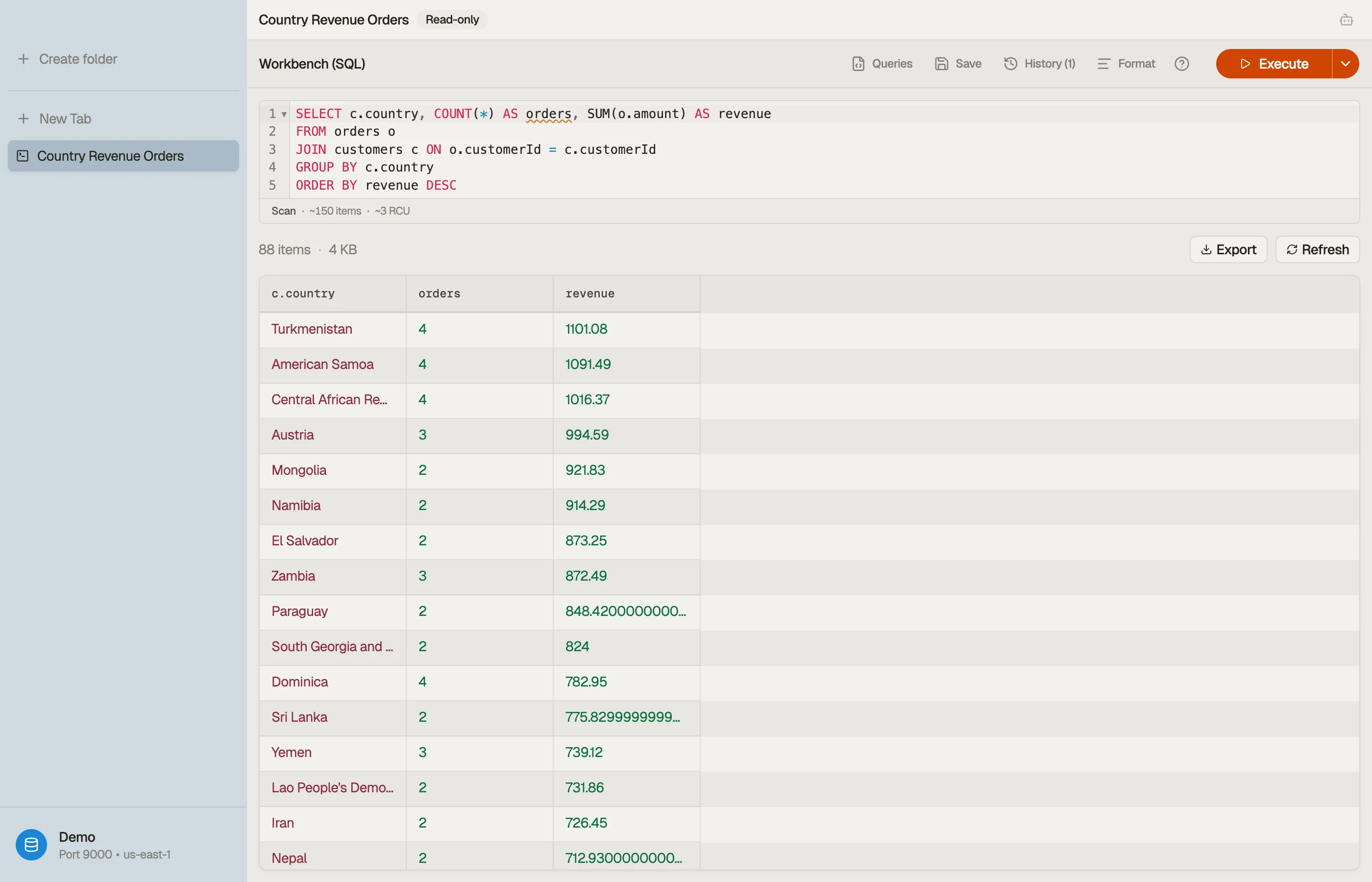
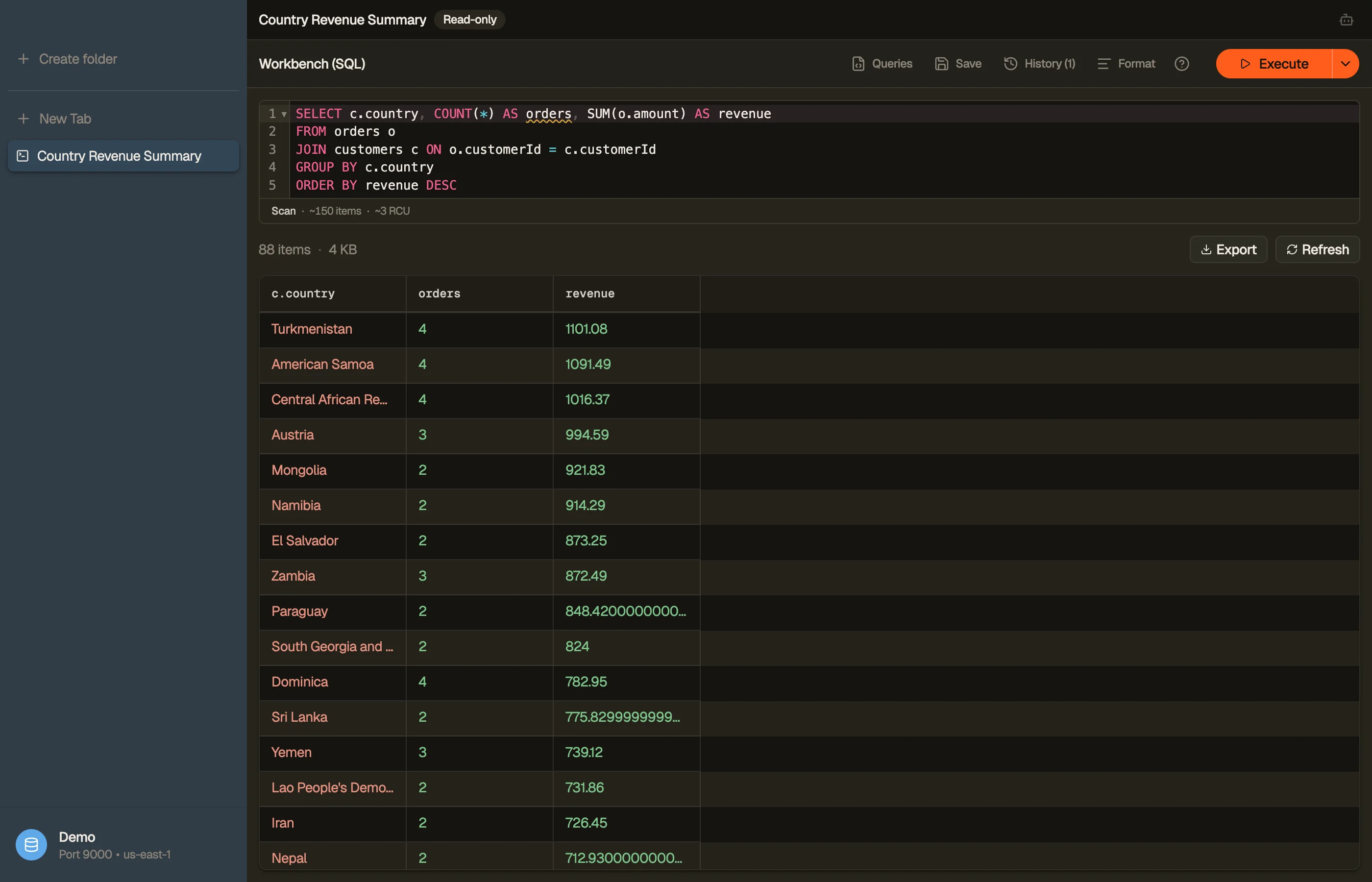
Full disclosure: this is our tool. DynoTable is a desktop DynamoDB GUI client whose differentiator is a SQL Workbench that compiles real SQL — INNER/LEFT JOIN, GROUP BY, and aggregates like COUNT, SUM, and AVG — down to DynamoDB's actual Query/Scan operations.
That matters because DynamoDB's own SQL surface can't. Per the PartiQL SELECT reference (checked 2026-08-06), the grammar is SELECT … FROM … WHERE … ORDER BY only: no JOIN, no GROUP BY, no aggregate functions. Every "supports SQL" claim in the table above is PartiQL underneath and hits this wall; the PartiQL vs SQL guide walks through exactly where.
-- Runs in the DynoTable SQL Workbench (NOT in PartiQL):
SELECT c.country, COUNT(*) AS orders, SUM(o.total) AS revenue
FROM orders o
INNER JOIN customers c ON o.customerId = c.PK
GROUP BY c.country
ORDER BY revenue DESCThe Workbench is honest about its rules, because they ARE DynamoDB's rules: one SELECT at a time, INNER/LEFT JOIN only, and a join target that must be a partition key or GSI partition key. That's SQL within DynamoDB's access-pattern rules, not a magic layer over a full scan.
The daily-driver basics are covered the same way:
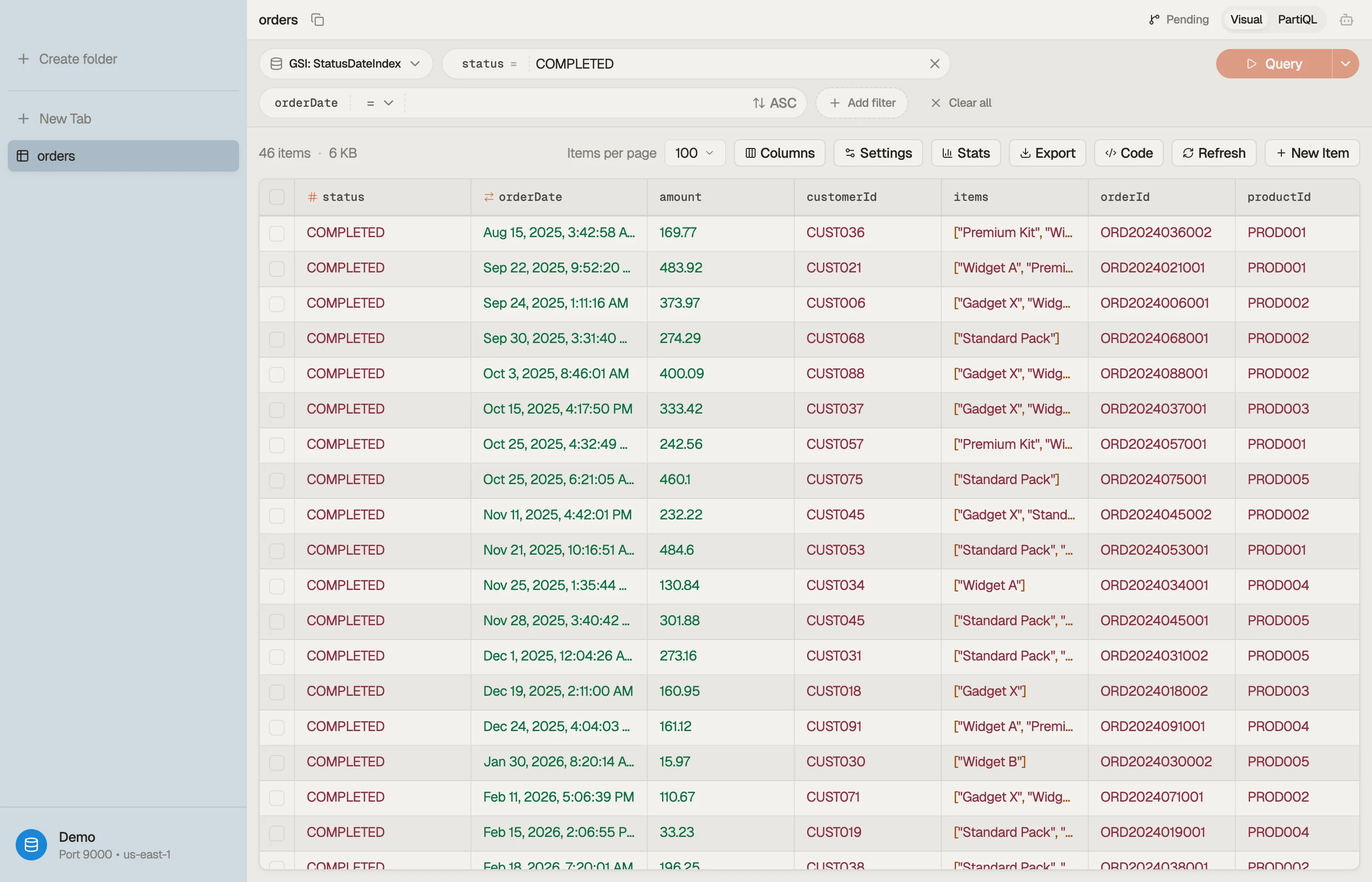
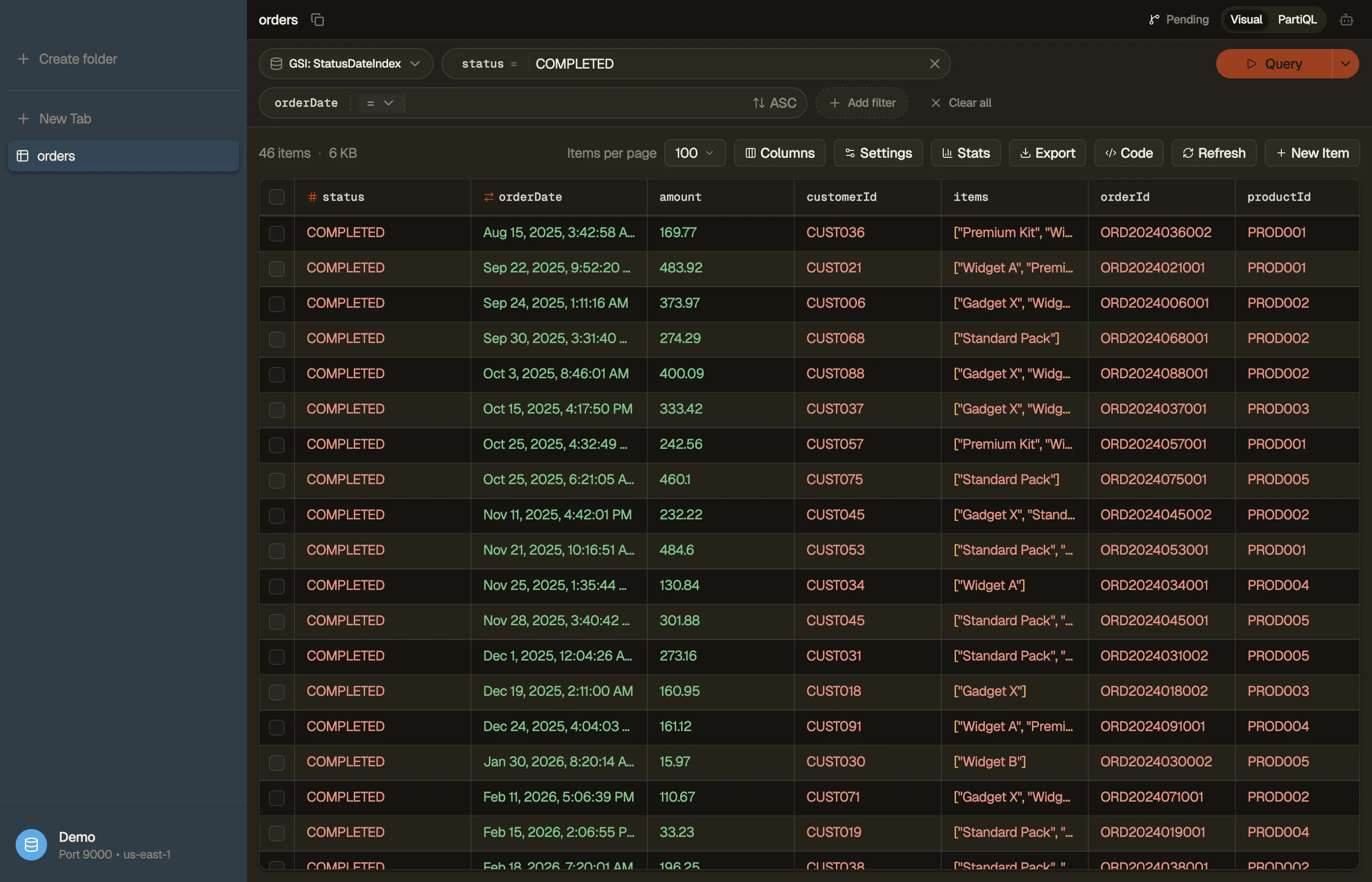
- Visual query builder: pill-based filters with an index picker and automatic Query-vs-Scan derivation, so you can see when a filter degrades to a scan.
- Query cost up front: in the SQL Workbench and the PartiQL editor, a status bar estimates items and read cost before you run, where the plan is known. That's the guardrail the warning about production scans above is asking for.
- Staged writes: edits stage locally into a reviewable diff before anything commits to DynamoDB. (One caveat, stated because it's true: PartiQL DML executes directly with a warning, it does not stage.)
- Credentials done right: the five AWS credential kinds auto-detected from
~/.aws, SSO device flow in-process, MFA TOTP in-app, and DynamoDB Local profiles. - AI on your own Bedrock: the agent runs in your AWS account and cannot write to DynamoDB directly; its writes go through the same staged diff you review. You pay AWS for the tokens.
Your table data never touches a DynoTable server: reads and writes go from the app to your AWS account, and your AWS credentials never leave your machine.
What DynoTable does not do: the control plane is read-only, so no table create/delete, no GSI or TTL configuration, no capacity editing, and no backups. There's no CloudWatch monitoring, no data import (export only), and no bulk update. A profile is one region, the macOS build is Apple Silicon only, and a license covers 2 machines. If those are your daily needs, pick from the tools above.
Pricing: a free read-only plan (account required), and paid from $12/month, or $9/month billed annually; the 30-day trial needs no credit card. See DynoTable as a DynamoDB GUI for the full category comparison.
Verdict: the right pick when your questions are analytics-shaped and PartiQL leaves you stuck; the wrong pick if you need table administration.




What is the best DynamoDB GUI client?
It depends on the job. NoSQL Workbench is the best free modeling tool, Dynobase is the most feature-complete commercial client, Dynomate is the pick for Git-shareable query collections, DocKit is the best free option if you also work across Elasticsearch or MongoDB, dynamodb-admin is the standard for local development, and DynoTable adds the SQL Workbench that runs JOINs, GROUP BY, and aggregates that PartiQL can't. Start from the work you do most and the choice usually makes itself.
Is there a free DynamoDB GUI?
Yes, several. AWS NoSQL Workbench is free and cross-platform (and the safest "official" choice); DocKit is free, open-source, and a genuine live-data client; dynamodb-admin and DynamoIt are free and open-source for local work; and DbVisualizer and Dynomate both ship free tiers with limited feature sets (verified 2026-08-06).
None of the free options run cross-table JOIN/GROUP BY/aggregates; they query DynamoDB through single-table PartiQL. For relational-shaped questions over DynamoDB data, that's where a paid SQL Workbench earns its keep.
What's a good DynamoDB GUI for Mac, Windows, or Docker?
All the desktop clients here ship for macOS, Windows, and Linux; note DynoTable's macOS build is Apple Silicon only, while DbVisualizer and NoSQL Workbench also cover Intel Macs. For Docker-based local setups, dynamodb-admin is the usual pick: point --dynamo-endpoint at the amazon/dynamodb-local container's exposed port. DynoTable and Dynobase also connect to local endpoints, including LocalStack.
Can a DynamoDB GUI run real SQL, with JOINs and aggregates?
Not through PartiQL. DynamoDB's PartiQL SELECT grammar has no JOIN, GROUP BY, or aggregate functions (per the AWS reference, checked 2026-08-06), so any client that "supports SQL" via PartiQL — Dynobase, DataGrip, DbVisualizer, DocKit — hits the same wall. A tool has to plan and compile those queries into DynamoDB's Query/Scan operations itself; DynoTable's SQL Workbench is built to do exactly that. If you only need the raw filter or key conditions for a single API call, the DynamoDB Expression Builder generates the correct FilterExpression / KeyConditionExpression without any SQL surface at all.
Do I still need a GUI if I have the AWS Console?
Many people switch precisely because of the Console's limits: weak filtering, clumsy pagination, and no real export. A purpose-built GUI adds fast filtering, inline editing, query building with cost visibility, and one-click export. The DynamoDB Console alternative page walks the gap feature by feature.
Related
- Concepts the right tool should make easy: query vs scan, single-table design, and the PartiQL vs SQL gap that the SQL Workbench fills (with worked PartiQL examples).
- Free tools that run in your browser, no install: the DynamoDB JSON converter and the Expression Builder.
- Head-to-head pages: DynamoDB GUI client overview, Dynobase, Dynomate, NoSQL Workbench, DataGrip, and TablePlus.
- Download DynoTable and run a JOIN against your own tables.
Pricing and version claims verified 2026-08-06 against each vendor's own pages; TablePlus's DynamoDB-connector capabilities are the older 2026-06-10 check, flagged where they appear. Re-check before relying on any of them. Product names are trademarks of their respective owners; referenced here for identification only.