DynamoDB Item-Based Actions
DynamoDB's API splits into three families: item-based actions that work on a single
item by its primary key, Query which reads a range within one partition, and
Scan which reads everything. This guide is the first family — the four operations
you use most: GetItem, PutItem, UpdateItem, DeleteItem. They're the cheapest,
fastest calls DynamoDB offers, and getting their distinctions right (especially Put
vs Update) prevents a class of accidental-data-loss bugs.
What are DynamoDB's item-based operations?
DynamoDB's item-based operations are the four calls that act on a single item by its full primary key: GetItem reads it, PutItem creates or completely replaces it, UpdateItem modifies specific attributes in place, and DeleteItem removes it. Each addresses exactly one item, making them the fastest, cheapest calls — unlike Query and Scan, which read many.
GetItem— read one item by its full primary key.PutItem— create or completely replace one item.UpdateItem— create or modify specific attributes of one item in place.DeleteItem— remove one item by its full primary key.- All four require the complete primary key (partition key, plus sort key if the table has one) — they address exactly one item.
PutItemoverwrites the whole item;UpdateItemis surgical — confusing them is how attributes silently disappear.
The defining trait: one item, full key
Every item-based action targets a single item by its complete primary key. That's what makes them fast and cheap — DynamoDB hashes the partition key, goes straight to the item, done. No filtering, no scanning. If you don't know the full key, these aren't the right tool; that's what Query and Scan are for.
Say you run user accounts keyed by USER#<id>:
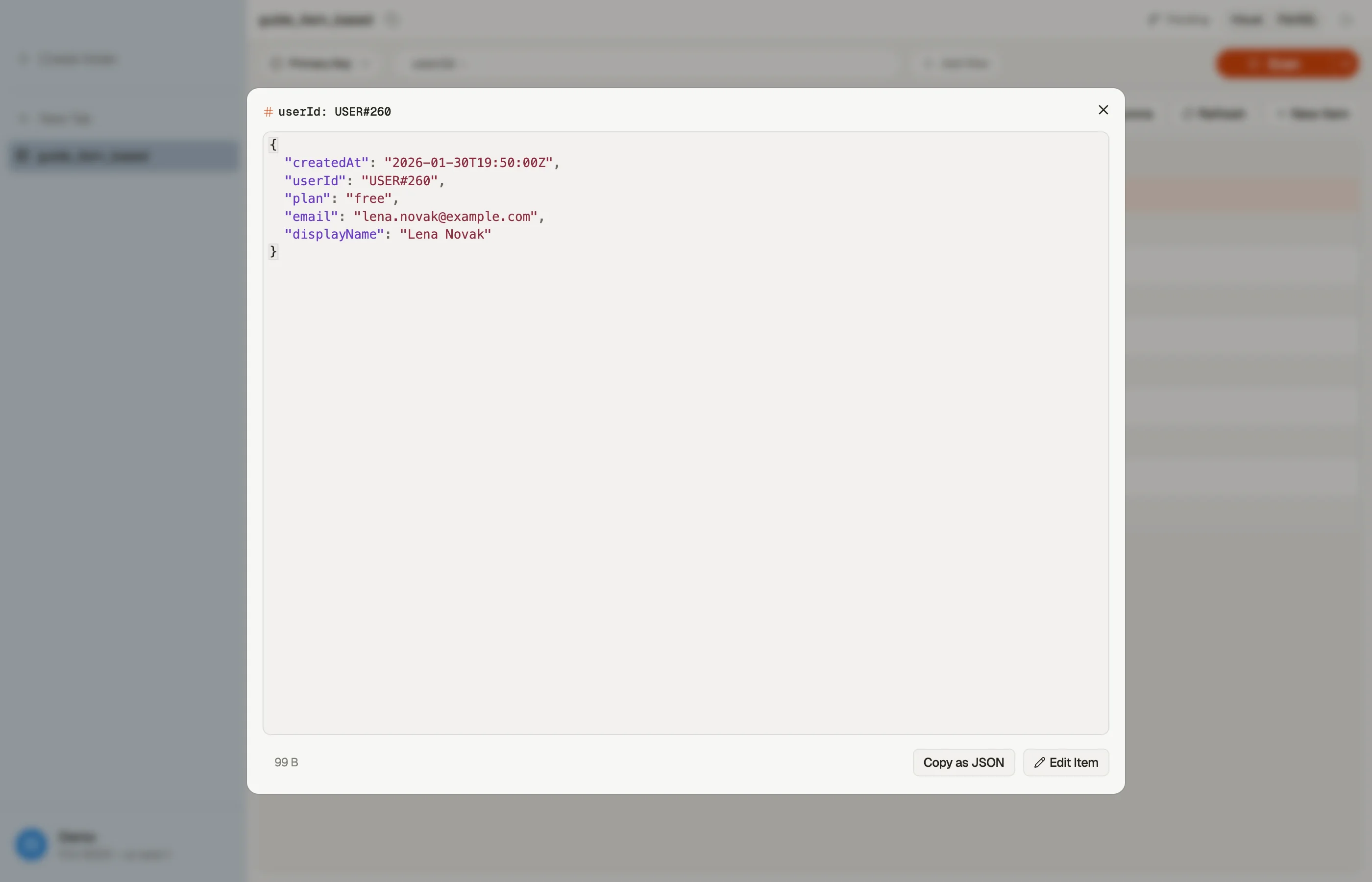
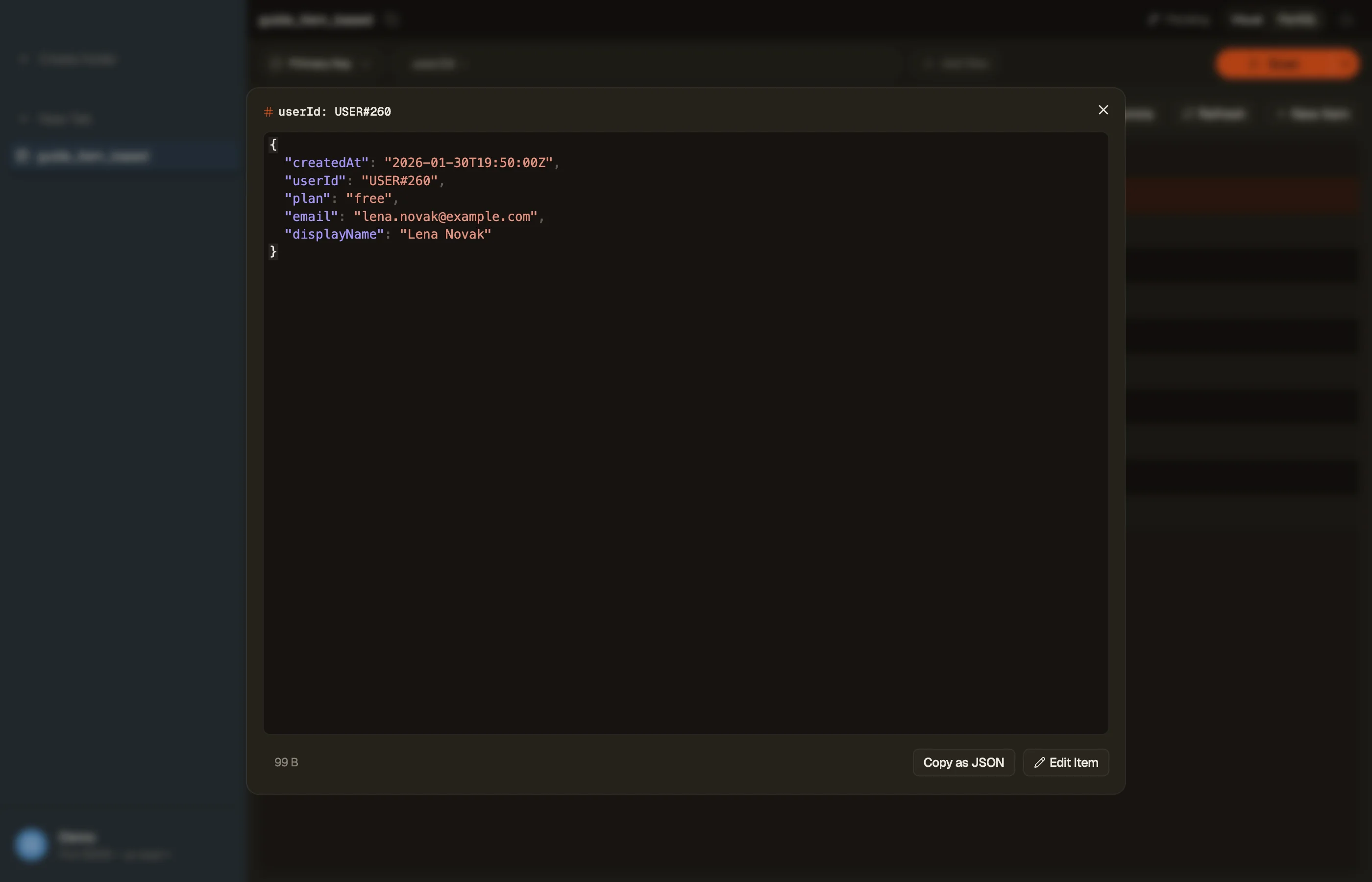
PK: USER#204 email, displayName, plan, createdAtGetItemonUSER#204→ that user, directly.DeleteItemonUSER#204→ removes that user.
Both need the exact key. No key, no item-based action.
PutItem vs UpdateItem — the one that bites
This is the distinction worth internalizing:
PutItemwrites the entire item. IfUSER#204already exists and youPutItemwith just{email, displayName}, the existingplanandcreatedAtattributes are gone — a put replaces the whole item, it doesn't merge.UpdateItemchanges only what you name.UpdateItemwith aSET email = …leaves every other attribute untouched, and creates the item if it didn't exist (an upsert).
Rule of thumb: reach for UpdateItem to change an existing item, and use PutItem
only when you genuinely mean "write this item as the complete new state." Both
PutItem and UpdateItem accept a
condition expression so you can make the write
conditional ("only if it doesn't already exist").
Item-based actions in DynoTable
Want the raw API calls behind these actions? Assemble the expressions and typed value maps in the DynamoDB expression builder, and convert a plain-JSON item into the API's typed format with the DynamoDB JSON converter.
In DynoTable, that same work is visual: open an item in the grid to read it (a
GetItem), edit attributes and commit (an UpdateItem), add or replace a row (a
PutItem), or delete one — one item at a time.


Pitfalls + next steps
PutItemreplaces the whole item — to change a few fields without losing the rest, useUpdateItem.- You must know the full primary key — no key means Query/Scan, not an item action.
- Many items at once? Don't loop these one by one — batch operations fold them into fewer round trips.
- Need the old/new value back? Set
ReturnValuesinstead of a follow-upGetItem. - Related: query vs scan covers the read-many side.
Want to read, write, and delete items without writing a line of API code? Download DynoTable and work with your tables directly.
Cost: one item, one hop
Item-based reads are the cheapest addressable access in DynamoDB. A GetItem on
a 2 KB row consumes 1 eventually-consistent RCU (one 4 KB block, rounded
up). A Query that returns the same row because you knew the partition key and
sort key costs the same capacity — but if you only know the partition key and
filter in application code, you pay for every item in the partition.
| Operation | Keys required | Typical use | Capacity shape |
|---|---|---|---|
GetItem | Full primary key | Point read by id | 1 block per item |
PutItem | Full primary key | Create or replace whole item | 1 WCU per KB, rounded |
UpdateItem | Full primary key | Patch attributes | Bills for item size written |
DeleteItem | Full primary key | Remove row | Same as a write on item size |
Query + filter | Partition (+ optional sort condition) | Many items in one partition | Sum of matched items |
Paste a representative item into the
item-size calculator, then multiply by
requests per second in the
pricing calculator when a hot path uses
GetItem in a loop versus one well-keyed Query.
Condition expressions on writes
Both PutItem and UpdateItem accept optional
condition expressions. Typical patterns:
attribute_not_exists(pk)on put — create-only insert without a race.attribute_exists(pk)on update — refuse to create a stub accidentally.plan = :oldon update — optimistic concurrency; retry if another writer changed the plan first.
DeleteItem supports conditions too — delete only if status = :closed, for
example. Conditions do not add a separate read charge; DynamoDB evaluates them
against the stored item during the write attempt.
Build conditions visually in the
DynamoDB expression builder; copy the
ConditionExpression plus ExpressionAttributeNames and
ExpressionAttributeValues into your SDK call.
Idempotency and overwrite safety
PutItem without a condition is last-writer-wins on the entire item. For webhook
handlers or SQS consumers, pair puts with attribute_not_exists on a processed
marker attribute, or use UpdateItem with SET processed = :true guarded by
attribute_not_exists(processed).
When you need the previous attribute values for an audit log, add
ReturnValues on the same UpdateItem instead
of a preceding GetItem — one round trip, no read/write race.
Choosing the right item action
| Intent | Call | Guard |
|---|---|---|
| Read profile by user id | GetItem | — |
| Create user if absent | PutItem | attribute_not_exists(pk) |
| Change email, keep other fields | UpdateItem | optional email <> :old |
| Replace entire config blob | PutItem | only when the payload is complete |
| Remove closed ticket | DeleteItem | status = :closed |
| Read 50 tickets by known keys | BatchGetItem | not 50× GetItem in serial |
Staging writes in DynoTable
DynoTable stages UpdateItem and PutItem locally before commit. You review
attribute diffs, run optional PartiQL checks, then commit — which maps to the
real API calls above. Bulk row deletes batch into
BatchWriteItem under the hood with retry
on unprocessed items.
For SDK code generation, assemble update clauses in the expression builder and paste the emitted SDK v3 snippet next to your handler tests.