DynamoDB Data Types: Every Type, with Examples
Every DynamoDB attribute is tagged with a one- or two-letter type code in the wire format. Knowing the set matters because the type drives both how a value is stored and how it counts toward an item's size.
What data types does DynamoDB support?
DynamoDB supports ten data types across three categories. Scalars are String (S), Number (N), Binary (B), Boolean (BOOL), and Null (NULL). Documents are Map (M) and List (L), which nest other types. Sets are String Set (SS), Number Set (NS), and Binary Set (BS) — unordered, homogeneous, and non-empty. Only S, N, and B can be a key.
| Code | Type | Category | JSON / JS equivalent | Example (DynamoDB-JSON) |
|---|---|---|---|---|
S | String | Scalar | string | {"S": "Ada"} |
N | Number | Scalar | number | {"N": "37"} |
B | Binary | Scalar | Uint8Array / base64 | {"B": "ZGF0YQ=="} |
BOOL | Boolean | Scalar | boolean | {"BOOL": true} |
NULL | Null | Scalar | null | {"NULL": true} |
M | Map | Document | object | {"M": {"k": {"S": "v"}}} |
L | List | Document | array | {"L": [{"N": "1"}]} |
SS | String set | Set | — (no JSON type) | {"SS": ["a", "b"]} |
NS | Number set | Set | — | {"NS": ["1", "2"]} |
BS | Binary set | Set | — | {"BS": ["ZA=="]} |
Scalars
S— string (UTF-8; sized by its byte length, not character count).N— number, sent as a string for precision; up to 38 digits.B— binary, sent base64-encoded.BOOL—true/false.NULL— an explicit null marker.
Documents
M— map (object). Nested attributes each keep their own type tag.L— list. Elements may be mixed types.
{"profile": {"M": {"name": {"S": "Ada"}, "age": {"N": "37"}}}}Sets
SS— string set,NS— number set,BS— binary set.
Sets are unordered, homogeneous, and can't be empty. Crucially, plain JSON has
no set type — an array round-trips as a list (L), never an SS/NS. That's a
real conversion limitation, not a bug; see the
DynamoDB-JSON converter note.
Which types can be a key?
Partition and sort keys — on the table and on any index — must be a scalar,
and only S, N, or B. You can't key on a boolean, set, map, or list. Model a
"composite" key by concatenating values into one S (e.g. ORDER#2026#42).
Limits worth knowing
- An item maxes out at 400 KB — every attribute name plus value, including nested ones.
- Numbers carry up to 38 digits of precision (positive or negative).
- Maps and lists nest up to 32 levels deep.
- Sets are non-empty and homogeneous — no empty set, no mixing
SandN.
Why the type affects cost
Item size is the sum of attribute-name bytes plus value bytes, and each type sizes differently — numbers are compacted, booleans and nulls are 1 byte, maps and lists add per-element overhead. That size rounds up to read/write capacity units. Measure a real item with the item-size calculator.
Do it in DynoTable
The set-vs-list distinction above is the thing tooling usually hides. DynoTable's item editor makes it explicit with a format toggle:
- Plain JSON — primitives stay plain (
"age": 30), but sets keep their type wrapper so they survive the round-trip:"tags": { "SS": ["a", "b"] },"scores": { "NS": ["1.5", "2.5"] }. This is the readable form for everyday editing. - DynamoDB JSON — the canonical AWS marshalled form, where every value
carries its type tag:
"age": { "N": "30" },"name": { "S": "alice" }.
Switching between them shows you exactly how each scalar, document, and set type
is represented on the wire — and because the set types have no plain-JSON
equivalent, the toggle is the only way to author an SS/NS/BS by hand without
hand-marshalling the whole item.

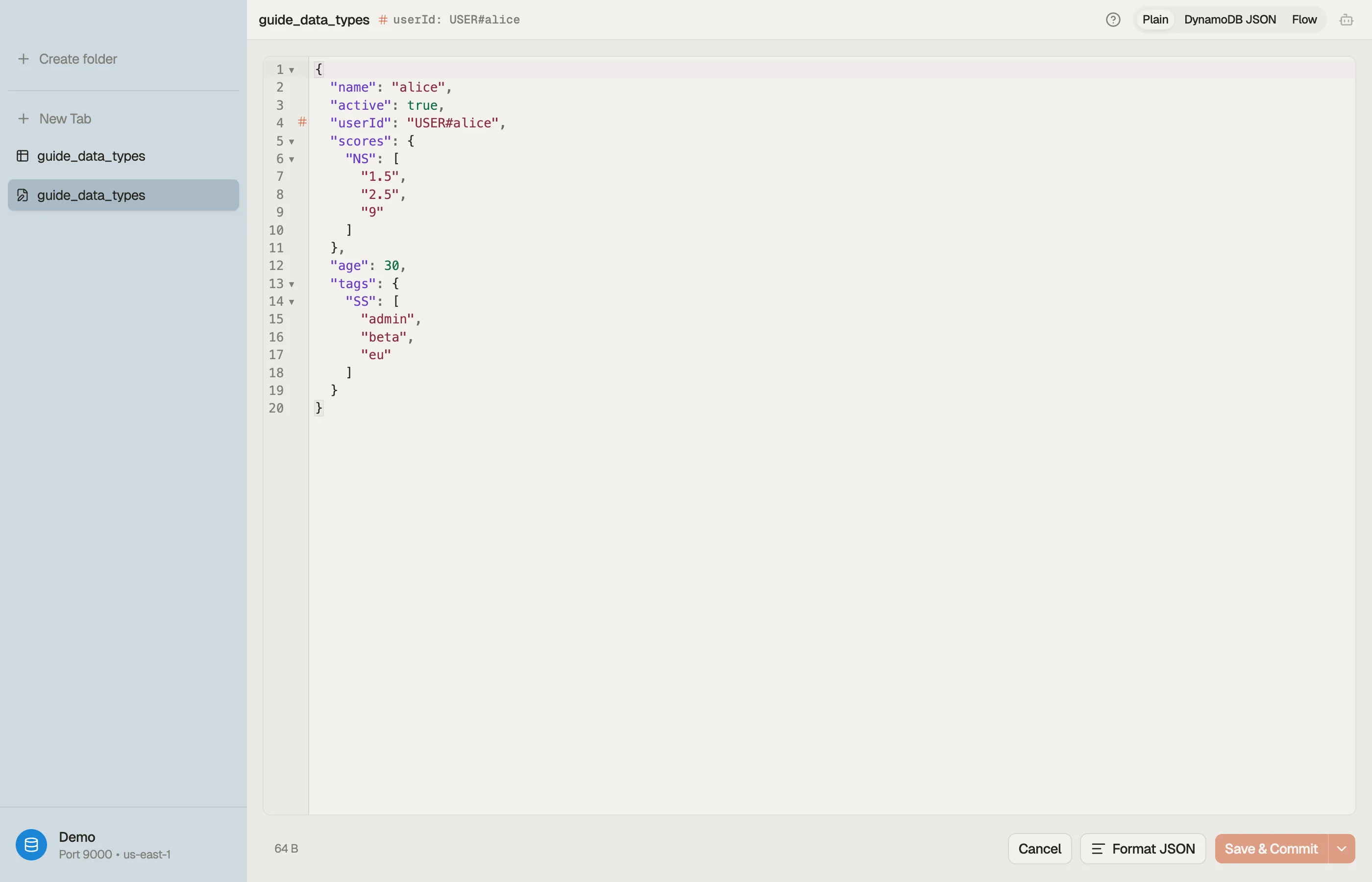

Try DynoTable to see every attribute's type and the live byte count as you edit an item — and to filter or aggregate across typed attributes in the SQL Workbench, which reads each type tag for you. To convert a marshalled blob without the app, the DynamoDB-JSON converter does the same round-trip in the browser.
Picking a type on purpose
The wire format is not neutral — it constrains keys, size, and how you query.
| You need… | Prefer | Avoid | Why |
|---|---|---|---|
| A primary or index key | S, N, or B | BOOL, M, L, sets | Keys must be scalar S/N/B |
| Exact decimal money | N as string | JSON number in app code | 38-digit precision on the wire |
| Unique tags on an item | SS | L of strings | Sets dedupe; lists allow duplicates |
| Ordered history | L or a sort key | SS | Sets are unordered |
| Nested profile blob | M | Flattened S JSON | Maps keep typed children |
| Binary thumbnail | B | Base64 in S | B is the native binary type |
A common mistake is storing tags: ["a","b"] in plain JSON, letting the SDK
marshal it as L, then wondering why a ConditionExpression expecting SS
never matches. The item-size calculator and DynoTable's format toggle make that
visible before the write lands.
Size example with real units
Take a minimal user profile:
{
  "pk": {"S": "USER#42"},
  "email": {"S": "a@example.com"},
  "plan": {"S": "pro"},
  "score": {"N": "1280"}
}Paste the item into the
item-size calculator. A typical result
is roughly 80–120 bytes depending on attribute names — well under one 4 KB read
block, so a GetItem costs 1 eventually-consistent RCU (half that if you
accept eventual consistency on the base table). Add a 2 KB bio map and the
same read still stays in one block until you cross 4 KB.
Nested maps charge per element: each child attribute name plus typed value adds
bytes. A deeply nested M inside M tree can push an item toward the
400 KB cap faster than flat attributes with
the same information.
Numbers ride as strings for a reason
DynamoDB stores N values as decimal strings with up to 38 digits. JavaScript
numbers are IEEE-754 doubles — roughly 15–17 significant digits. Marshalling
9007199254740993 through plain JSON can silently round; marshalling through
DynamoDB JSON preserves the exact string "9007199254740993".
When you author expressions that compare numbers, placeholders still use string
forms in ExpressionAttributeValues: {":n":{"N":"42"}}. The
expression builder emits those maps
correctly so you do not mix untagged literals into a ConditionExpression.
Sets in application code
Because JSON lacks a set type, application code often uses arrays. If the domain
requires uniqueness — tag sets, role sets, id sets — write SS/NS/BS
explicitly. DynoTable's Plain JSON mode keeps set wrappers visible during edit;
the DynamoDB JSON toggle shows the canonical { "SS": [...] } form.
For query access, remember sets are not keys. Model lookup ids as S or N keys
and store set-valued attributes as payload fields filtered after the key
condition — or denormalize membership into adjacency items if you need to query
by membership at scale.
Practice path in DynoTable
Connect a table, open any item, and flip Plain JSON ↔ DynamoDB JSON while
watching the live byte counter. Change an L to an SS and commit — the diff
makes the type tag explicit. Run a SQL Workbench SELECT over typed columns;
strings, numbers, and maps surface as distinct types in the result grid, which
helps when imported CSV data assumed everything was a string.
Download DynoTable to edit with typed controls instead of guessing attribute descriptors in the CLI.